The Difference Between Mystery and Confusion
There is a peculiar belief among some writers that if readers do not know what is happening, the writing must therefore be mysterious.
This is rather like believing that if your guests cannot find the bathroom in your house, you have successfully designed a maze.
You have not.
You have simply created a problem.
Mystery and confusion are often mistaken for one another because they share a superficial similarity. In both cases, the reader lacks information. In both cases, there are questions. In both cases, there is uncertainty.
Yet they are not siblings. They are not even distant cousins.
One is an invitation. The other is a locked door.
One creates curiosity. The other creates irritation.
The difference between them is among the most important lessons a writer can learn.
Because mystery keeps readers turning pages.
Confusion makes them put the book down and check whether they accidentally skipped a chapter.
The Human Brain Hates Vacuums
Humans are curious creatures.
Give us a puzzle, and we become obsessed.
Tell us there is a secret and we want to know it.
Mention a hidden room in a house, and suddenly, nobody cares about the kitchen anymore.
A mystery exploits this tendency.
It presents a knowledge gap.
Not a random gap.
Not a hole torn accidentally into the fabric of the story.
A deliberate gap.
A carefully designed absence.
The reader knows enough to understand that something is missing.
And more importantly, they know that the missing piece matters.
That is the essence of mystery.
The reader understands the question but does not yet possess the answer.
Confusion works differently.
In confusion, the reader often does not understand the question.
Or the situation.
Or the relationships.
Or occasionally the language.
Instead of wondering what happens next, they are wondering what just happened.
These are entirely different mental states.
One pulls the reader forward.
The other drags them backwards.
Mystery Creates Questions
Confusion Creates Question Marks
Imagine opening a novel and reading:
“The body was found at dawn. Nobody knew how it had entered the locked room.”
Instant mystery.
The situation is clear.
The question is clear.
The problem is clear.
A body.
A locked room.
No explanation.
The reader understands everything except the crucial piece.
That missing piece becomes irresistible.
Now imagine reading:
“The room entered itself before dawn, while the body remembered the second key and Jacob’s reflection became Tuesday.”
This is not a mystery.
This is literary soup.
Somewhere, a writer is congratulating themselves on their complexity.
Meanwhile, the reader is searching for clues that the book may have been printed in the wrong order.
Mystery asks a question.
Confusion obscures the question itself.
Readers Need Orientation
One of the strangest misconceptions in writing is that readers enjoy being lost.
They do not.
Readers enjoy feeling uncertain about outcomes.
They do not enjoy feeling uncertain about basic reality.
Think of a detective story.
The detective enters a room.
The reader knows where they are. They know who the detective is. They know what the detective wants.
What they do not know is who committed the crime.
That uncertainty creates tension.
Now, remove all orientation.
The reader does not know where the detective is. They do not know who the detective is. They do not know why anyone is present.
They do not know whether the crime happened yesterday or during the reign of Charlemagne.
The mystery has disappeared.
Only confusion remains.
Readers need a map.
Not a complete map.
A partial map.
Enough landmarks to understand where they stand.
Mystery happens when parts of the map are hidden.
Confusion happens when the map itself catches fire.
The Power of the Known Unknown
Good mysteries operate through what might be called the known unknown.
The reader knows exactly what they do not know.
Who killed the victim?
Why did the woman disappear?
What is hidden in the attic?
Why is nobody allowed beyond the northern wall?
These questions are clear.
Specific.
Focused.
The reader can hold them in their mind.
Confusion creates unknown unknowns.
The reader does not know what they are supposed to know.
The target keeps moving.
Questions multiply without structure.
Instead of curiosity, the reader experiences cognitive overload.
Imagine assembling a jigsaw puzzle.
Mystery removes several pieces.
Confusion removes the picture from the box.
Mystery Builds Trust
Confusion Destroys It
This is perhaps the most overlooked distinction.
Mystery requires trust.
The reader must believe the writer knows what they are doing.
Every unanswered question is essentially a promise.
The writer is saying:
“You do not understand this yet.”
The reader replies:
“Fine. I’ll wait.”
That agreement is sacred.
The moment readers suspect the writer has no answers themselves, the spell breaks.
Many stories begin mysteriously and end disappointingly because the writer confuses withholding information with having information.
They planted questions they never intended to answer.
They opened doors leading nowhere.
They built intrigue without foundations.
Readers are remarkably tolerant of uncertainty.
What they cannot tolerate is betrayal.
A mystery says:
“Trust me.”
Confusion says:
“I hope nobody notices I am improvising.”
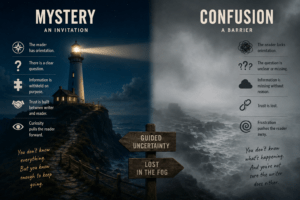
The Fog and the Lighthouse
Imagine standing on a coastline at night.
There is fog everywhere.
You cannot see the sea.
You cannot see the horizon.
You cannot see what lies ahead.
Yet in the distance, a lighthouse flashes.
That lighthouse is understanding.
The fog is the mystery.
You do not know everything.
But you know enough.
You have direction.
Now remove the lighthouse.
Only fog remains.
That is confusion.
The problem is not the darkness.
The problem is the absence of orientation.
Readers can tolerate astonishing amounts of uncertainty if they can still see the lighthouse.
Why Writers Accidentally Create Confusion
Usually from fear.
The fear of being predictable.
The fear of explaining too much.
The fear of appearing simple.
Writers often discover subtlety and immediately overdose on it.
They remove context.
They remove explanations.
They remove motivations.
They remove cause and effect.
Soon, the story resembles a magic trick performed entirely behind a curtain.
Nothing is revealed because nothing is visible.
Ironically, many of the greatest mysteries are extremely clear.
Think about classic detective fiction.
The language is clear.
The setting is clear.
The characters are clear.
The mystery itself is often the only unclear thing.
The writer does not hide everything.
They hide one thing.
And because everything else is visible, that missing piece becomes magnetic.
Literary Fiction Is Not Exempt
A common misconception is that confusion becomes acceptable once a work is labelled literary.
This is comforting nonsense.
Literary fiction may embrace ambiguity.
It may resist easy answers.
It may leave questions unresolved.
But ambiguity is not confusion.
The difference matters enormously.
Ambiguity occurs when multiple interpretations remain possible.
Confusion occurs when no interpretation remains possible.
One creates thought.
The other creates headaches.
A reader can finish a literary novel and wonder what it means.
That can be rewarding.
A reader should not finish a literary novel and wonder what happened.
Those are different experiences.
The first invites discussion.
The second invites aspirin.
Mystery Lives in the Reader
This is perhaps the most beautiful aspect of storytelling.
Mystery is not actually located in the plot.
It exists inside the reader.
The writer creates empty spaces.
The reader fills them with questions.
A mystery is therefore a collaboration.
The writer provides enough information to stimulate curiosity.
The reader provides the curiosity itself.
Confusion breaks this partnership.
The reader cannot participate because they lack the necessary foundation.
Imagine trying to solve a crossword puzzle where half the clues are written in disappearing ink.
Eventually, even the most enthusiastic participant gives up.
Not because the puzzle is difficult.
Because it is impossible.
The Test
Whenever you write a mysterious scene, ask yourself a simple question.
Can the reader clearly explain what they do not know?
If the answer is yes, you probably have the mystery.
If the answer is no, you probably have the confusion.
Let’s compare.
Mystery:
“I know Sarah entered the house. I know she never came out. I want to know where she went.”
Confusion:
“I am not entirely certain who Sarah is, whether she entered a house, whether the house exists, or whether I accidentally skipped three pages.”
The distinction is brutal.
And useful.
Great Mysteries Illuminate
This sounds contradictory.
A mystery should illuminate?
Absolutely.
The best mysteries reveal constantly.
Every answer generates new questions.
Every discovery changes understanding.
The reader learns more and more, even as uncertainty remains.
Imagine climbing a mountain.
Each step reveals more of the landscape.
The summit remains hidden.
That is mystery.
Confusion is climbing a mountain while someone repeatedly places a sack over your head.
One creates anticipation.
The other creates liability concerns.
A story should become clearer as it progresses.
Not necessarily simpler.
Clearer.
The reader’s understanding should expand.
Questions should evolve.
The world should gain definition.
Even if the central mystery remains unsolved.
The Writer’s Secret Responsibility
Many writers think their responsibility is to surprise readers.
It is not.
Their responsibility is to guide readers.
Surprise is merely one tool.
Guidance is the real task.
A reader should never feel abandoned.
Misled occasionally?
Certainly.
Manipulated for dramatic effect?
Without question.
Abandoned?
Never.
The writer is a tour guide through uncertainty.
The reader willingly follows.
But they must feel the guide knows where the path leads.
The moment that confidence vanishes, mystery collapses into confusion.
The Final Difference
Mystery is a promise.
Confusion is a failure of communication.
Mystery says:
“There is something here worth discovering.”
Confusion says:
“Something has gone wrong.”
Mystery sharpens attention.
Confusion scatters it.
Mystery makes readers lean forward.
Confusion makes them reread paragraphs.
Mystery creates anticipation.
Confusion creates exhaustion.
The two may look similar from a distance.
Both contain uncertainty.
Both contain missing information.
Both contain shadows.
But one contains intention.
The other contains absence.
And perhaps that is the simplest way to understand the distinction.
A mystery is a shadow cast by something real.
Confusion is often a shadow cast by nothing at all.
As writers, we should never fear mystery.
Mystery is one of storytelling’s oldest and most powerful tools.
It is the whisper behind the door.
The footprint in fresh snow.
The unopened letter.
The name crossed out in an old diary.
The strange light at the top of the hill.
It is the force that persuades readers to turn one more page when they should really be asleep.
Confusion has no such magic.
Confusion is simply the reader standing in the dark, wondering whether the electrician ever arrived.
One enchants.
The other inconveniences.
The difference is everything.
Before you go, explore these related ideas:
Crafting Atmosphere: Techniques for Poetic Prose
Off Script: Why We Question, Where Philosophy Came From, and What It Means to Think Differently
The Essential Role of Empathy in Writing: Why It’s the Most Important Skill for an Author
The Author’s Operational System: How to Organise Your Writing Like a Professional
If these words stayed with you, share them.
Disclaimer: Featured image generated with AI.
A quiet chamber behind the visible world.
We value your trust!
Your address is safe in the vault.
We’ll only use it to send you letters worth opening; no spells, no spam, no secret salesmen.